Moline Epoxy Flooring installs metallic epoxy floor systems in Moline, IL, serving surrounding cities including Silvis, Milan, Rock Island, Campbell’s Island and Bettendorf. With more than 20 years in concrete floors, we treat metallic epoxy as the most demanding finish we offer, because every flaw in the slab and every move the installer makes ends up in the final pattern.
A metallic floor uses pearlescent pigments suspended in clear epoxy. As the resin is spread and worked, the pigments flow, swirl and settle, creating a marbled, three-dimensional look that can resemble polished stone, flowing water or molten metal.
That effect depends on a flat, sound, dry slab and a crew that works quickly and consistently. Our proposals name the primer, the metallic body coat, the topcoat and the finished thickness, so you know what is building the look you are paying for.
Where Metallic Epoxy Floors Work Best
Finished Basements and Living Spaces
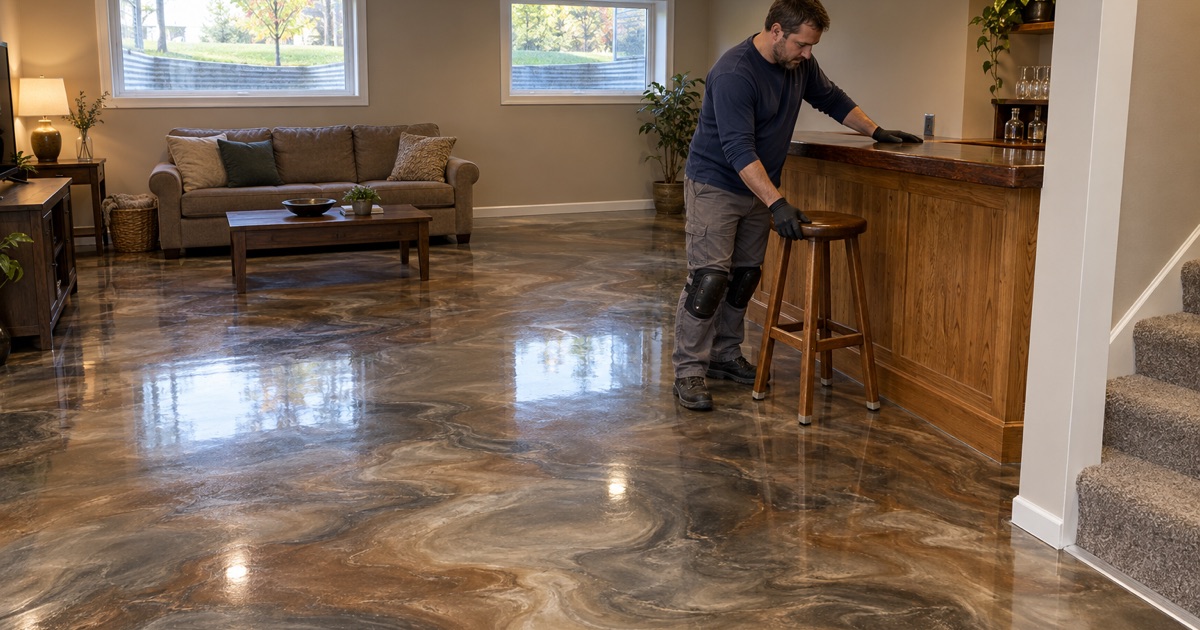
In a finished basement, a metallic floor gives a dramatic, seamless surface that is easy to clean and does not trap allergens the way carpet can. It suits family rooms, bars and home theaters where the floor is part of the design.
Basements also bring the moisture question. We test the slab before quoting and read the floor for past water, checking the floor drain and any sump pit, because a metallic floor that blisters from below is ruined in a way that is hard to repair invisibly.
Showrooms, Salons and Retail
Businesses use metallic floors to make a space memorable. Showrooms, salons, boutiques and restaurants get a floor that looks custom and photographs well, while still cleaning like any other epoxy floor.
On commercial jobs, we phase the work around opening hours, often pouring overnight or over a weekend, and close off the area so dust and odor stay in the work zone.
Show Garages and Clean Workshops
A metallic garage floor is a statement, and it suits owners who keep the space very clean. It shows dust, tire marks and scratches more than a flake floor, so we are honest about the upkeep before you choose it.
In a garage, the clear topcoat matters most. We use a UV-stable, abrasion-resistant topcoat that holds up to hot tires and the rock salt brought in over the winter.
Our Step-by-Step Metallic Epoxy Floor Process
Step 1: Testing and Mapping the Slab
We test the slab for moisture with an ASTM D4263 plastic sheet test, moving to ASTM F1869 calcium chloride or ASTM F2170 relative humidity readings when the result needs a number. We also map cracks, spalls, high spots and low spots.
Flatness matters more for metallic epoxy than for any other coating. Pigment collects in low areas and thins over high ones, so an uneven slab shows up as dark puddles and pale ridges in the finished floor.
Step 2: Grinding and Repairs
The slab is diamond ground to open the surface and take down high spots. Cracks, spalls and low areas are filled and ground flush, and old coatings, adhesives and sealers are removed down to sound concrete.
The grinder’s dust is captured by a vacuum at the machine. Acid etching is never part of the process, because it leaves an uneven surface with no reliable profile.
Step 3: Primer and Base Color
A primer coat seals the concrete and keeps air from rising out of the slab into the metallic layer, which would otherwise leave pinholes. A tinted base coat follows to set the background color the metallic will sit on.
The base color changes the final look. A dark base deepens the metallic effect, while a lighter base makes the pigments read brighter and softer.
Step 4: The Metallic Body Coat
The metallic epoxy is mixed in batches, poured and spread across the floor, then worked with rollers, trowels or other tools to move the pigment. The crew works in a planned sequence so each batch blends into the last before it begins to set.
This is where the skill is. Too little movement leaves a flat look, too much leaves a muddy one, and a stopped edge shows as a line. Experience is what keeps the pattern consistent from wall to wall.
Step 5: Clear Topcoat
Once the metallic layer cures, a clear topcoat protects it from scratches, chemicals and sunlight. We usually use a polyaspartic or urethane topcoat because most epoxies amber in ultraviolet light, which would shift the colors you picked. The topcoat can be gloss or satin, and a fine grit can be added where slip resistance matters more than maximum depth.
Colors, Patterns and Effects
Choosing Colors
Metallic pigments come in silvers, golds, coppers, blues, grays and many blends. Two or three colors can be combined for more depth, and the base coat color changes how each one reads.
We show samples in your colors before the job, and we recommend viewing them in the light of the actual room, since metallic finishes shift with the angle and brightness of the light.
Marble, Lava and Ocean Looks
Different techniques create different effects. Long sweeping strokes produce flowing, river-like movement, tight cells produce a lava look, and layered veins in white and gray can resemble marble. We agree on the style before pouring and describe it in the proposal, so the crew and the customer are working toward the same picture.
Borders and Accent Areas
A metallic floor can be bordered with a solid color, divided into zones or used as an accent area inside a larger flake or solid floor. That approach puts the dramatic finish where it matters most and keeps busy areas easier to maintain.
In a business, a metallic accent can mark an entry, a display area or a bar front while the work areas get a more forgiving flake finish. At home, it can define a bar or theater area inside a larger coated basement.
Caring for a Metallic Floor
Daily care is a soft dust mop and a damp mop with a neutral cleaner. Grit tracked in from outside is the main thing that dulls the topcoat, so mats at entries make a real difference.
When the topcoat eventually shows wear in traffic lanes, it can be lightly sanded and a fresh clear coat applied. The metallic layer underneath stays untouched, so the pattern you chose lasts much longer than the shine on top of it.
What to Know Before You Commit
Temperature and Cure
Metallic epoxy needs a warm, steady slab to flow and cure properly. A cold slab thickens the resin and changes how the pigment moves, and moisture condensing on a surface near the dew point can cause amine blush and a cloudy finish. We read the slab temperature and dew point spread before each coat, and reschedule rather than pour into conditions that would compromise the look.
Rules on Each Side of the River
In Illinois, floor coatings must meet the VOC limits in 35 Ill. Adm. Code Part 223, which apply to whoever applies the coating, so every Illinois metallic floor uses compliant materials. In Iowa, the federal 40 CFR 59 Subpart D rule governs manufacturers, and a low-odor product is a comfort choice there.
Warranty Limits
Like any coating, a metallic floor warranty typically excludes moisture vapor transmission and hydrostatic pressure from below. We explain those limits before you sign, because on a metallic floor a moisture failure is especially visible.
- 20+ Years on Concrete Floors
- Moisture Tested Before Pricing
- Diamond Ground, Never Acid Etched