
Moline Epoxy Flooring installs basement floor epoxy in Moline, IL, serving surrounding cities including Silvis, Milan, Rock Island, Campbell’s Island and Bettendorf. In more than 20 years of coating concrete, we have found that basement floors fail for one main reason, moisture, so the moisture question is the first thing we answer on every basement.
A coated basement floor is bright, easy to clean and far more pleasant than bare gray concrete. It suits laundry rooms, workshops, storage areas, home gyms and finished living spaces, as long as the slab underneath is ready for it.
Before we price a basement, we test the slab, look for signs of past water and check the floor drain and any sump pit. If the floor is not a good candidate for a coating yet, we say so plainly instead of selling a system that will lift in a year.
Reading a Basement Before It Is Coated
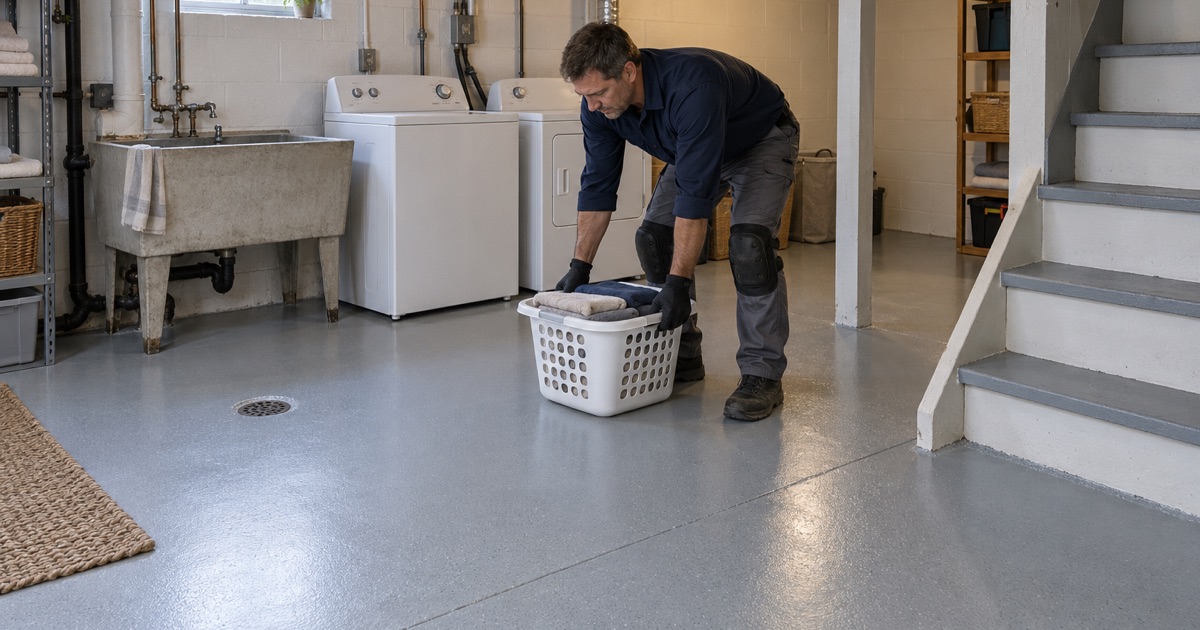
Testing the Slab for Moisture
Basement slabs sit in contact with the soil, and moisture moves up through concrete as vapor even when the floor looks dry. We start with an ASTM D4263 plastic sheet test and use ASTM F1869 calcium chloride kits or ASTM F2170 relative humidity probes when the floor needs a measured number.
The result goes into the written scope before the price is final. It decides whether a standard epoxy will hold, whether a moisture-mitigation primer is needed, or whether the floor should not be coated until something else is fixed.
Signs of Past Water
We look at the walls and the floor for water lines, stains, rust on stored items and efflorescence, the white mineral powder that moisture leaves behind as it evaporates. Each of those tells us water has moved through or onto the slab before.
Older homes often have a history the current owner does not know. Reading that history in the concrete is part of deciding whether a coating belongs on the floor.
Floor Drains, Sump Pits and Drain Tile
We check the floor drain and any sump pit before quoting, because they show how water has been managed in the basement. A sump pit that runs often, or a drain that has backed up, points to water a coating cannot stop.
When we coat, we finish neatly to drain rims and sump covers so the coating does not trap water at the edges or interfere with drain tile around the perimeter.
Moline Basements and the Water Around Them
Older Homes and Layers of Old Material
Most of Moline’s housing was built before 1980, and older basement floors often carry decades of paint, patching compound and black tile mastic. All of it has to come off before a coating goes down, because the new system bonds only as well as the weakest layer under it.
We remove those layers with diamond grinding, never acid etching, and capture the dust at the machine with a vacuum. On older homes, we raise the question of testing old tile and mastic before grinding them.
River Flooding and Basement Recovery
The Mississippi River reached its highest crest on record at Rock Island on May 2, 2019, at 22.70 feet, and the Rock River ran above flood stage at Moline more than once that spring. Basements near both rivers and in low areas took on water.
After any flooding, a basement floor has to be cleaned, dried and retested before coating. Coating a slab that is still releasing water traps it under the film, and the coating will blister as that moisture tries to escape.
Hydrostatic Pressure Under the Slab
When the water table rises, water can press up against the underside of a basement slab. That hydrostatic pressure pushes liquid water through cracks and joints and can force a coating off the floor.
A moisture-mitigation primer is designed for vapor, not for water under pressure. If testing or the history of the house points to hydrostatic pressure, we tell you the floor needs drainage work first.
Choosing a Basement Floor System
Standard Epoxy Systems
For a dry, sound slab, a 100% solids epoxy base with a clear topcoat gives a durable, cleanable floor. Solid colors suit utility areas and workshops, while a vinyl flake broadcast hides dust and small imperfections in living spaces. We list the product line, number of coats and finished thickness in the proposal, so you know exactly what is going on your floor.
Moisture-Mitigation Primers
When testing shows moderate vapor emission, a moisture-mitigation primer is applied first to hold the system on the slab. It adds cost and time, so we only specify it where the test result calls for it.
It is not a cure for every damp floor. It handles vapor moving up through sound concrete, not liquid water coming through cracks or rising from a high water table.
Texture for Laundry, Bathrooms and Gyms
Wet areas need grip. In laundry rooms, near basement bathrooms and in home gyms, we add texture through the flake broadcast or a fine aggregate in the topcoat. The texture is specified in writing so it is not a vague promise of a non-slip floor.
The amount of texture is a tradeoff. More grit means more grip but a floor that is harder to mop, so we match it to the room: heavier where water is common, lighter in a family room where the floor mostly sees socks.
Workshops, Storage and Home Gyms
A basement workshop floor takes dropped tools, oil and solvents, so it gets a thicker system and a solid or light flake finish that makes small parts easy to find. Storage areas benefit from a coating that keeps concrete dust off boxes and makes spills easy to clean.
Home gyms need a surface that handles sweat, cleaners and the occasional dropped weight. We often recommend rubber mats over a coated floor in lifting areas, with the coating providing a clean, sealed surface everywhere else.
What the Coating Is Not
Not Waterproofing
A coating seals the surface against spills and stains. It does not stop water from entering through walls, cracks or the joint where the wall meets the floor, and we put that in writing before the job is sold.
If water is the problem, the fix is usually outside the coating trade: gutters and grading, drain tile, a working sump pump or crack injection in the walls. Once the water is under control and the slab has dried and been retested, a coating can go down with a much better chance of lasting.
Not Radon Mitigation
Moline adopted the IRC appendix on radon control methods along with its 2021 residential code, and that appendix concerns how new homes are built. A coating on an existing basement floor is not radon mitigation, and a home with a radon concern should be tested and handled by a mitigation specialist.
What the Warranty Leaves Out
Most floor coating warranties exclude moisture vapor transmission and hydrostatic pressure. We explain that before you sign, because in a basement those are the conditions most likely to cause a problem, and you should know where the coverage ends.
Our written proposal pairs those exclusions with the test results we took, so you can see why we recommended the system we did. If conditions change later, such as a new leak or a failed sump pump, that record shows what the floor looked like when it was coated.
- 20+ Years on Concrete Floors
- Moisture Tested Before Pricing
- Diamond Ground, Never Acid Etched