
Moline Epoxy Flooring installs epoxy garage floor systems in Moline, IL, serving surrounding cities including Silvis, Milan, Rock Island, Campbell’s Island and Bettendorf. After more than 20 years on concrete, we start every garage the same way: grind the slab, test it for moisture and map every crack before a price is set.
A garage floor around here works hard. It takes hot tires in July, slush and rock salt from November to March, oil drips, dropped tools and the weight of everything stored on it. The coating has to be built for that whole year, not just for how it looks the afternoon it is finished.
Our proposals spell out the product line, how many coats go down and the finished thickness, so the floor you get can be checked against the paper. That matters when you are comparing a full system against a thin kit, because the price difference is mostly what you cannot see.
What Goes Into a Garage Floor Coating
Diamond Grinding the Slab
Every garage slab we coat is opened with a diamond grinder, which removes the weak, dusty top layer of the concrete, along with sealers, oil stains on the surface and old paint. What is left is a clean, open profile the epoxy can bite into. Acid etching skips that step and leaves a slick, inconsistent surface, which is a big reason store kits let go.
The grinder is connected to a dust-collecting vacuum, so the dust is captured at the machine instead of drifting into your house or being hosed out the door toward a storm inlet. On an attached garage we also seal the door into the house before we start.
Base Coat and Broadcast
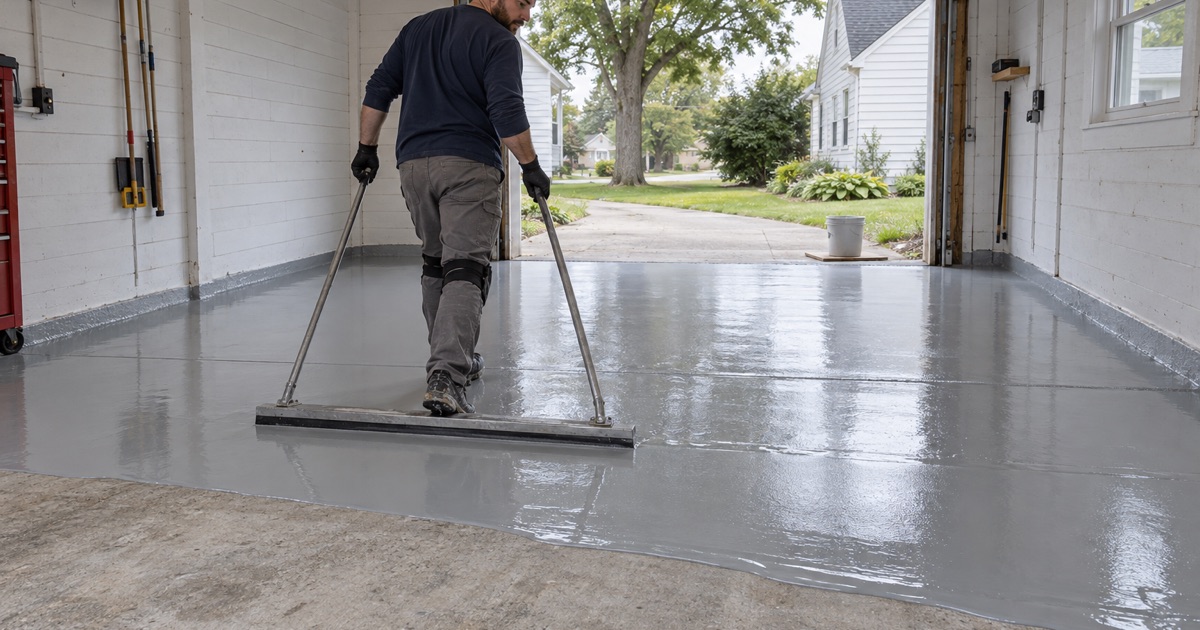
The base coat is usually a 100% solids epoxy, which builds real thickness in one pass and bonds well to a ground slab. While it is still wet, we broadcast vinyl flake, either to full coverage for the most forgiving finish or as a partial scatter for a lighter look.
Once the base cures, excess flake is scraped and vacuumed off, leaving a textured surface. That texture is what gives the finished floor grip under wet shoes, and it is set by how much flake goes down and how the topcoat is applied.
Clear Topcoat
The topcoat seals in the flake and takes the abuse of daily traffic. We usually use a polyaspartic or polyurea topcoat over an epoxy base, because those materials resist ultraviolet yellowing from an open garage door and hold up well to chemicals and abrasion.
Sheen is your choice. Gloss shows off the flake color, while a satin finish hides dust and tire marks better between cleanings.
Problems We Find Before We Coat
Moisture Coming Up Through the Slab
The International Residential Code lets garage floors skip the under-slab vapor retarder under R506.2.3, so many garage slabs have nothing between the concrete and the soil below. Ground moisture moving up through that slab can push a coating off from underneath.
We test before pricing, starting with an ASTM D4263 plastic sheet test and moving to ASTM F1869 calcium chloride or ASTM F2170 relative humidity readings when the first result calls for a number. The result decides whether the floor needs a moisture-mitigation primer, a different system or a wait.
Cracks, Spalls and Salt Scaling
Winters of rock salt and calcium chloride on bare concrete cause freeze-thaw scaling, where the surface flakes and pits near the door and along the tire paths. Cracks and spalls also open up as slabs age. We map all of it, fill the damage with repair material and grind it flush so it does not show through the coating.
When the slab is broken through, heaved or crumbling across large areas, we tell you the floor should be repaired or replaced before it is coated. A coating over failed concrete looks good for a season and then cracks with the slab.
Old Coatings and Oil Stains
Peeling paint, earlier epoxy and deep oil stains all compromise the bond. Loose coatings are ground off completely, and oil-soaked areas are cleaned and ground until the concrete underneath is sound. A new system is only as strong as the weakest layer under it, so we do not coat over something that is already letting go.
Garage Floors Through a Quad Cities Year
Coating in Cold Weather
Epoxy cures by temperature, and a cold slab slows it down badly. When the surface sits close to the dew point, moisture condenses on it and can cause amine blush, a waxy film that weakens the bond between coats and dulls the finish.
We read the slab temperature and the dew point spread at the surface before each coat goes down. Moline’s own building code sets the local frost line at 42 inches, which tells you how cold the ground gets here, and an unheated garage in deep winter is usually a job we tell you to hold until spring.
Salt, Slush and Winter Cleanup
The main reason many homeowners coat a garage in this area is the winter. A coated, sealed floor keeps salt brine on the surface where you can squeegee it out the door, instead of letting it soak into the concrete and break the surface apart from the inside.
We choose garage systems for that exposure and recommend a texture that gives grip without trapping slush. A floor drain or a slight slope toward the door makes cleanup even easier, and we finish the coating neatly to both.
Hot Tires in the Summer
Hot tire pickup happens when a tire that has been driven on hot pavement softens a thin coating and lifts it off the floor as the car pulls out. It is one of the most common complaints about cheap garage coatings.
A ground slab, a thick 100% solids base and a hard polyaspartic topcoat are what prevent it. That combination is also why we do not recommend a one-coat paint for a garage that sees daily driving.
Detached Garages and Moline’s Slab Rules
The City’s Floating Slab Specification
Moline’s building code, adopted under Ordinance 3031-2023 with the 2021 International Residential Code, allows a detached garage of up to 720 square feet to sit on a floating slab. That slab must be at least 4 inches of air-entrained concrete reaching 3,000 psi at 28 days, poured continuously with no cold joints.
Air-entrained concrete has tiny air bubbles that help it survive freeze-thaw cycles, and it grinds a little differently than a dense interior slab. We adjust the grinding to reach the profile the coating needs without overcutting the surface.
Working Outside the House
A detached garage keeps grinding dust and coating odor out of the home entirely, which makes it a straightforward job. The tradeoff is that detached garages are rarely heated, so the timing of the work matters more and the cure schedule follows the weather closely.
Illinois and Iowa Rules
On Illinois garage jobs we use floor coatings that meet the state’s VOC limits for the person applying them under 35 Ill. Adm. Code Part 223. On Iowa jobs in cities like Bettendorf, a low-odor product is a comfort choice rather than a legal requirement, and we do not pretend otherwise.
- 20+ Years on Concrete Floors
- Moisture Tested Before Pricing
- Diamond Ground, Never Acid Etched