
Moline Epoxy Flooring installs ESD flooring in Moline, IL, serving surrounding cities including Silvis, Milan, Rock Island, Campbell’s Island and Bettendorf. With more than 20 years of work on industrial and commercial floors, we approach static control floors as engineered systems, with a grounding plan, a target resistance range and test results, not just a coating color.
Electrostatic discharge can damage electronic components, disrupt sensitive equipment and, in some environments, ignite vapors or dust. An ESD floor gives that charge a controlled path to ground, working together with footwear and grounded workstations.
Our proposal names the system, the target resistance range, the grounding points and the testing we will do. That way the floor can be measured against what was promised, and the results go into your quality records.
Types of ESD Floors
Static-Dissipative Epoxy
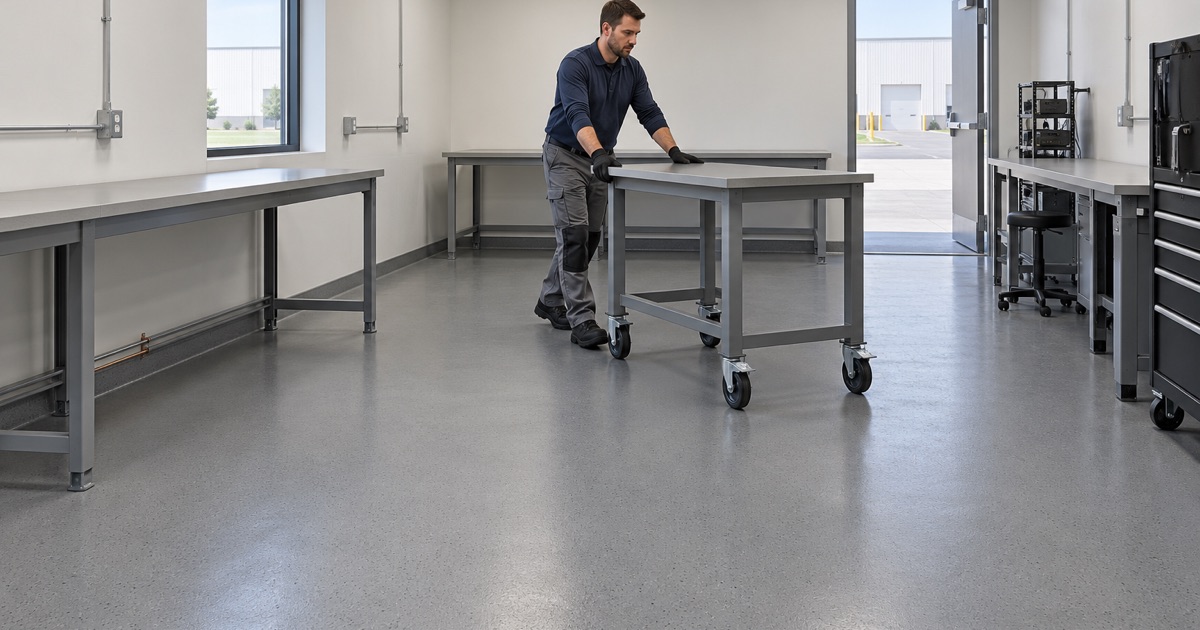
Static-dissipative floors carry charge to ground at a controlled rate. They are common in electronics assembly, repair benches, laboratories, server rooms and control rooms, where the goal is to keep people and carts from building up charge.
The range the floor needs to fall in usually comes from your quality program, a customer requirement or your equipment manufacturer. We confirm that range before choosing the system.
Conductive Epoxy
Conductive floors have lower resistance and move charge to ground faster. They are used where very sensitive components are handled or where static could ignite flammable materials.
Because conductive floors move charge quickly, they are specified carefully. We work from your required range and the standards your operation follows.
ESD Topcoats Over Existing Floors
Some facilities need static control over an existing sound floor. In those cases, we grind and prepare the surface, add grounding, and install a conductive primer and an ESD topcoat to bring the area into range.
Where ESD Floors Are Used
Electronics Assembly and Repair
Circuit boards and electronic components can be damaged by a static discharge too small for a person to feel. Assembly lines, repair benches and test areas use ESD floors so that people and carts moving across the room do not carry a charge to the work.
In manufacturing areas that build controls and electronics for equipment, the floor is often one item on a customer’s quality checklist. We match the floor to the range that checklist requires.
Server Rooms, Control Rooms and Labs
Server rooms, dispatch and control rooms, and laboratories hold sensitive equipment that is expensive to replace and costly to have fail. A static-dissipative floor reduces the charge people bring into those rooms.
These spaces often run around the clock. We plan the work so equipment stays protected from dust, often installing in sections or during scheduled maintenance windows.
Areas With Flammable Vapors or Dust
Where solvents, fuels or combustible dusts are present, a static spark can be an ignition source. Conductive flooring may be specified in those areas as part of a broader safety plan.
Those requirements come from the facility’s own engineering and safety standards. We build to the specified range and document the results so the floor can be checked during audits.
How an ESD Floor Is Built
Surface Preparation
As with any coating, the slab is opened with a diamond grinder or shot blaster, repaired and tested for moisture first. An ESD system that lifts or cracks loses its continuity, which makes the static control unreliable. Grinding dust is captured at the machine with vacuums, which matters in facilities where dust itself is a contamination concern.
Grounding Points and Conductive Primer
Copper grounding strips or tape are laid on the prepared slab and connected to the building ground at set intervals. A conductive primer goes over them, spreading the conductive path across the whole floor. The layout of grounding points is planned around the room size and the location of available grounds, and it is recorded so future work can find them.
ESD Body Coat
The ESD epoxy body coat contains conductive fibers or fillers that carry charge through the coating to the primer below. It must go down at a consistent thickness, because thin or thick spots change the floor’s resistance.
ESD floors are usually a solid color, often gray or beige, because flake and metallic finishes interfere with the conductive path. The fibers in the coating may show as faint dark lines, which is normal and part of how the floor works.
Testing and Documentation
Resistance Testing After Installation
Once the floor cures, we test it with a resistance meter and electrodes at points across the area, both point to point and point to ground. Readings that fall outside the target range are investigated before we leave.
Testing is done after the floor has cured and been cleaned, because construction dust and residue on the surface can throw off the readings. The test points cover open floor, traffic lanes and the areas around workstations.
Records for Your Quality Program
We provide a test report with the readings and locations. Many quality programs require periodic retesting, and the original report gives you a baseline to compare against.
Footwear and Workstations
The floor is one part of a static control program. Workers need ESD footwear or heel grounders, and workstations need their own grounding. We can explain how the floor fits into the rest of the system.
A floor that tests well can still fail a walking test if footwear is missing or worn. Many facilities check people at the door with a footwear tester, and the floor is designed to work with that routine rather than replace it.
Planning an ESD Floor Project
Working Around Production
Electronics and lab areas often cannot stop for long. We phase work by area and schedule overnight or weekend installation where a line cannot be shut down.
Sensitive equipment is covered or moved out of each work area, and grinding dust is captured at the machine. Each section is tested before it goes back into use, so production returns to a floor that is already documented.
Moisture and Slab Condition
Moisture in the slab can affect both adhesion and electrical performance. We test before pricing and recommend a moisture-mitigation approach where the results call for it.
Maintenance That Keeps the Floor in Range
Waxes and many common floor finishes leave an insulating film that pushes resistance up. We provide cleaning guidance and recommend ESD-approved cleaners so the floor keeps performing after it is installed.
- 20+ Years on Concrete Floors
- Moisture Tested Before Pricing
- Diamond Ground, Never Acid Etched