
Moline Epoxy Flooring installs flake epoxy floor systems in Moline, IL, serving surrounding cities including Silvis, Milan, Rock Island, Campbell’s Island and Bettendorf. Over more than 20 years, flake has been the finish we install most often in garages, because it combines a durable build with a look that forgives dust, tire marks and the occasional scuff.
A flake floor starts with a pigmented base coat. While the base is still wet, we broadcast decorative vinyl chips across it, then scrape and vacuum the excess once it cures and seal everything under a clear topcoat.
Our proposals name the base coat, the flake blend and size, the broadcast coverage, the topcoat and the finished thickness. That makes it easy to compare our quote with another one and to check the floor once it is done.
Choosing a Flake Floor
Flake Blends and Colors
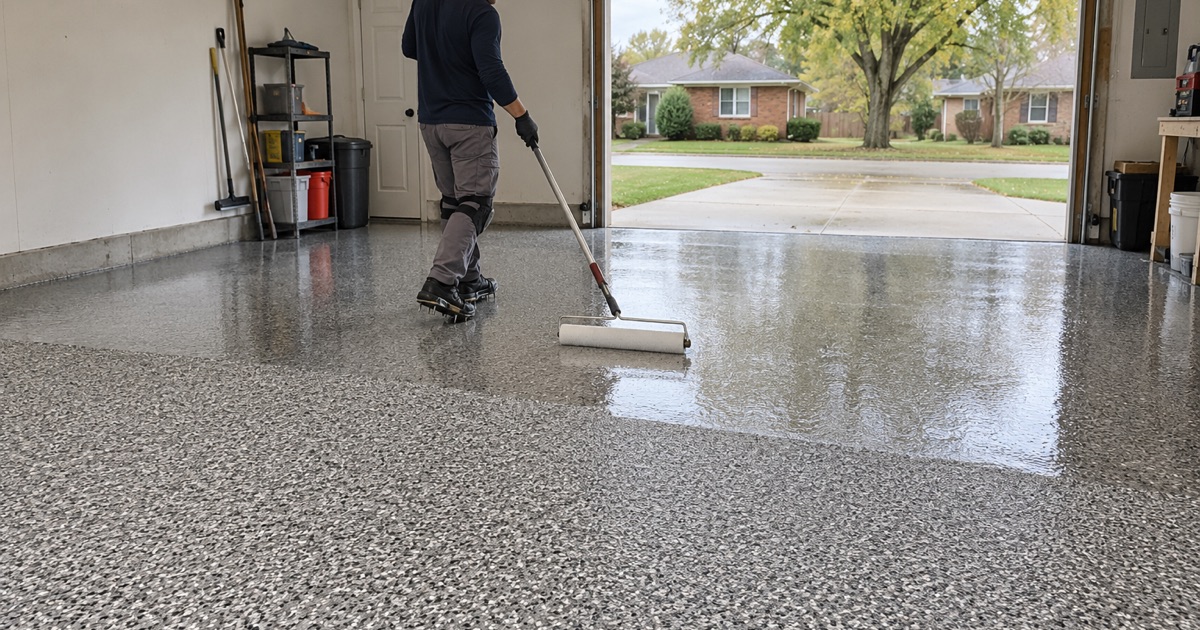
Vinyl flake comes in dozens of blends, from neutral grays and tans to bolder mixes with blues, reds and whites. Mixed blends hide dirt and tire marks better than single colors, which is why multi-color gray and tan blends are so common in garages.
We bring samples to the site, because flake looks different under garage lighting than in a brochure. Seeing the chips on your floor, in your light, is the best way to choose.
Chip Size
Chips range from small to large. Small chips give a tight, uniform finish that can look like granite, while larger chips give a bolder speckle and a little more texture under the topcoat.
Larger chips can create a slightly rougher feel underfoot. If you prefer a smoother surface, a smaller chip or an extra topcoat can help, and we can show both side by side.
Full or Partial Broadcast
With a full broadcast, chips cover the base coat completely. It is the most forgiving finish and the most popular in garages. With a partial broadcast, the base color shows between the chips for a lighter look that uses less flake.
A full broadcast also gives a more uniform texture, which helps with slip resistance. Partial broadcast floors can be smoother and may show dust more in the open areas of base color.
How a Flake Floor Is Built
Preparing the Slab
The slab is diamond ground or shot blasted to a profile the base coat can grip. Cracks, spalls and pitting are filled and ground flush, and old coatings are removed. We never acid etch.
Before any of that, the slab is tested for moisture. The result is written into the scope before the price is final, because moisture coming up from below is the most common reason a garage coating lifts.
Base Coat and Broadcast
The base coat, usually a 100% solids epoxy or a pigmented polyaspartic, goes down in a color that suits the flake blend. While it is still wet, flake is broadcast by hand across the floor in an even pattern.
Once the base cures, the crew scrapes loose and standing chips and vacuums the floor thoroughly. This step sets the final texture, so it is done carefully rather than rushed.
Clear Topcoat
A clear topcoat locks the flake in place and takes the daily wear. We usually use a polyaspartic or polyurea topcoat because it resists ultraviolet yellowing from an open garage door and holds up to hot tires, chemicals and abrasion.
A second topcoat or a fine grit additive can be added for more durability or more grip. Each option is listed in the proposal so you can choose what fits how the floor is used.
Flake Floors in Garages, Shops and Basements
Garages Through the Winter
Garage floors here take rock salt and calcium chloride brine from November through March. On bare concrete, that salt soaks in and contributes to freeze-thaw scaling. On a sealed flake floor, it stays on the surface where it can be squeegeed out.
We choose garage systems for that winter exposure and set cure schedules by slab temperature and dew point. An unheated garage in the middle of winter is usually best coated in spring.
Workshops and Commercial Spaces
Flake floors are common in workshops, auto service bays, commercial restrooms and break rooms. The texture and color mix hide wear between cleanings, and the seamless surface is easy to keep clean. In commercial spaces, we phase work around operating hours and capture grinding dust at the machine so the rest of the building stays clean.
Basements and Laundry Rooms
In basements, flake gives a warm, finished look and hides small imperfections in older slabs. The moisture test and a check of the floor drain and any sump pit come first, because a coating does not stop water that is already finding its way in. We also tell you in writing that a flake floor is not waterproofing or radon mitigation, so expectations are clear from the start.
Rules and Warranties
VOC Limits in Illinois
On Illinois jobs, we use floor coatings that meet the VOC limits in 35 Ill. Adm. Code Part 223, which apply to whoever applies the coating. On Iowa jobs, a low-odor product is a comfort choice rather than a legal requirement, and we explain the difference.
What the Warranty Covers
Coating warranties usually exclude moisture vapor transmission and hydrostatic pressure from below. We explain those exclusions before the job is sold, so you know where coverage ends and why we test the slab first.
Damage from heavy impact, chemicals outside the product’s rating and cracks caused by slab movement are also commonly excluded. Reading those terms before signing is part of choosing a floor, and we go through them with you line by line.
Comparing Flake Floor Quotes
Two flake floor quotes can look similar and describe very different floors. One may be a thin water-based coat over an etched slab with a light scatter of chips; another may be a ground slab, a 100% solids base, a full broadcast and two topcoats.
That is why our proposal lists each layer and the finished thickness. Ask for the same details from any contractor you are comparing, and the price difference usually explains itself.
- 20+ Years on Concrete Floors
- Moisture Tested Before Pricing
- Diamond Ground, Never Acid Etched